
Why Christ reaches for Adam and Eve.
A first look at the Orthodox icon of the Resurrection, and the hope it proclaims for every person.
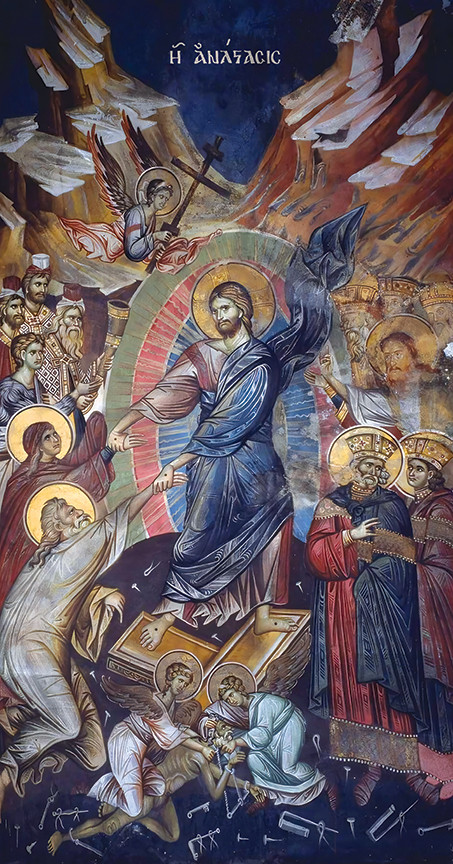
If you come from a Protestant background, the Orthodox icon of the Resurrection may surprise you. There is no empty tomb at its center and no risen Christ standing alone in a garden. Instead, Christ stands in the depths, above the shattered gates of Hades, drawing Adam and Eve out of death.
Beneath His feet the doors lie broken, often crossed in the shape of an X. Scattered locks, keys, and nails show that the prison of death has been emptied. With both hands, Christ takes hold of Adam and Eve and lifts them from their tombs. Called the Anastasis, the Greek word for resurrection, this is the icon Orthodox Christians venerate at Pascha.
Not a rescue from afar
The icon proclaims something the Church sings throughout the Paschal season: Christ did not defeat death from the outside. He entered it. The Son of God took on our humanity, went down into death itself, and broke it open from within. His victory becomes humanity’s hope.
“And he is the head of the body, the church: who is the beginning, the firstborn from the dead; that in all things he might have the preeminence.”
Why Adam and Eve?
Adam and Eve stand for all of us. Christ does not wait for them to climb out on their own; He reaches down and raises them. Salvation in this icon is an invitation into the life of God, offered to the whole human race from the very first man and woman.
In From the Depths of Hell, Fr. John Breck explores how this image expresses the unity of Christ’s Incarnation, Crucifixion, descent into Hades, Resurrection, and Ascension. He contrasts the Orthodox emphasis on healing and glorifying human nature with satisfaction-centered accounts influential in Western Christianity. The Son takes on our humanity, enters death, and raises us toward life with God. Salvation is an invitation to share in God’s life, not simply an account of punishment paid.
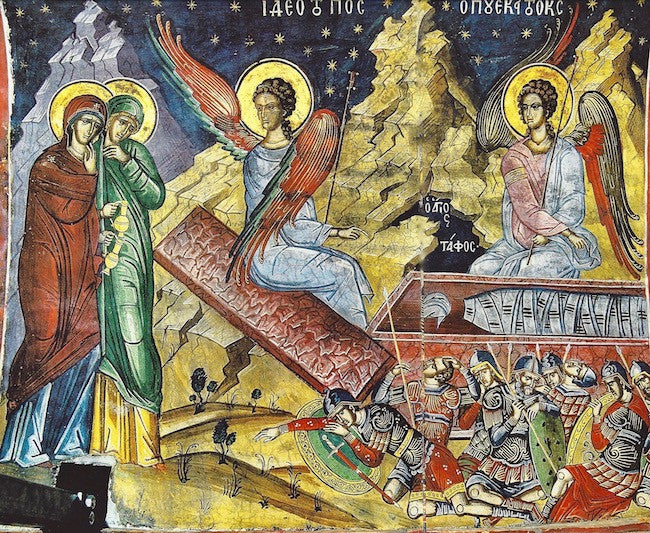
The empty tomb has its own icon, shown above, and both are honored in the Church. The Anastasis shows what was accomplished in the depths while the tomb lay sealed: Christ is risen from the dead, trampling down death by death, and upon those in the tombs bestowing life.